


Description
Allied Telesis AT-MR126F | CentreCOM IEEE 802.3 Micro Repeater
Product Introduction
While modern infrastructure runs on multi-gigabit switches, legacy manufacturing cells and specialized aviation systems still rely on rock-solid 10Mbps architecture. The Allied Telesis AT-MR126F is not an off-the-shelf consumer hub; it is a heavy-duty industrial micro-repeater engineered to clean up distorted waveforms and push the physical boundaries of older IEEE 802.3 networks—though deploying it today requires strict management of collision domains.
This unit tackles signal attenuation head-on by regenerating incoming packet frames before jitter leads to frame drops. Equipped with built-in jabber control, it automatically isolates misbehaving nodes that continuously transmit data, protecting the rest of the local segment from broadcast storms. It remains a prized asset for engineers maintaining vintage control networks where complete system migrations are economically unviable.
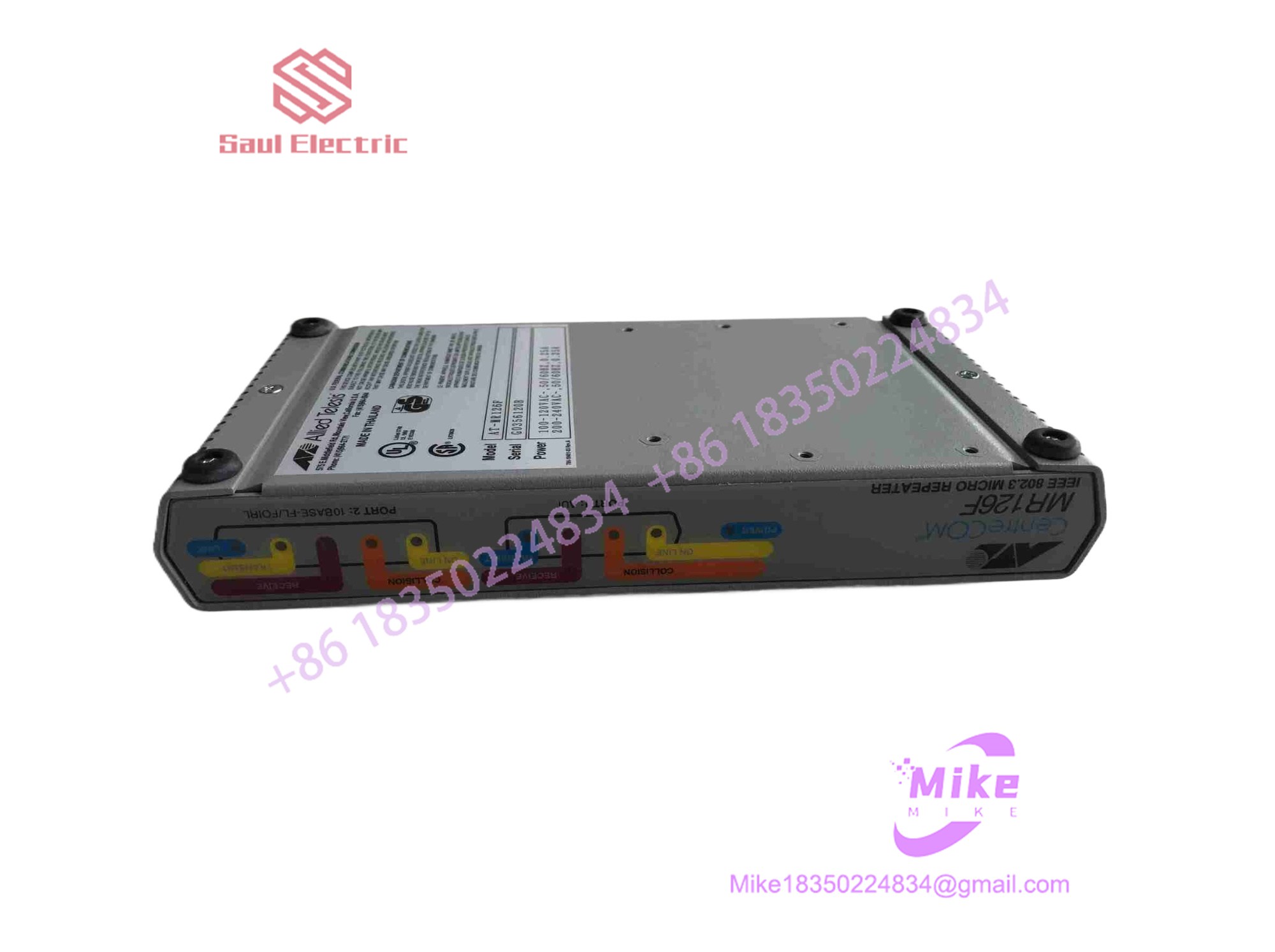
AT-MR126F
Key Technical Specifications
| Parameter | Value |
| Standard Compliance | IEEE 802.3, Ethernet Blue Book / 10 Mbps specs |
| Input Power | 100–240V AC, 50/60 Hz (0.25A max draw) |
| Diagnostic Features | Partition/Reconnection LED indicators, SQE/Heartbeat switch |
| Circuit Protections | Integral Jabber Lock-up Prevention |
| Media Interface | Port-dependent (Coaxial / Twisted Pair configurations depending on drop attachments) |
| Enclosure Type | Compact industrial metal chassis |
| Operating Temperature | 0°C to 40°C (Standard commercial/industrial rack limits) |
| Mounting Options | Desktop or standalone cabinet placement |
Application Scenarios & Pain Points
- Legacy Factory Floor Extensions: An automotive plant running vintage PLC programming loops over 10Base networks frequently experiences packet degradation over long cable runs. Inserting the AT-MR126F regenerates the signal mid-flight, bringing distant nodes back within safe attenuation margins.
- Isolating Rogue Node Failures: A malfunctioning network card locking up an entire collision domain can bring a production line to a halt. The internal jabber-lock prevention on this repeater automatically cuts off the offending port, keeping the rest of the loop online.
- Aviation and Defense Test Benches: Older diagnostic racks often lack modern auto-negotiation capability. This unit provides the exact bit-timing handshake required to bridge older transceiver drops without rewriting legacy protocol software.
QA & Live Testing SOP (Trust Signal)
Because these units originate from decommissioned or legacy setups, we verify every AT-MR126F on an active 10Mbps test harness. Our technicians power the unit through its internal 100-240VAC stage to check regulator stability. We pass a continuous stream of test frames through the ports, monitoring packet error rates with an oscilloscope to confirm that the internal retiming clock is locking cleanly without introducing latency spikes or frame truncation.
Field Engineer’s Pitfall Guide
- ❗ Collision Domain Over-Extension: Stacking too many repeaters in a single path violates the classic “5-4-3 rule” of 10Mbps Ethernet. Ensure you aren’t exceeding maximum propagation delay limits, or packets will collide and corrupt.
- ❗ SQE (Heartbeat) Switch Misconfiguration: Check the Signal Quality Error test switch position relative to your transceiver drops. Mismatching this setting can trick older controllers into registering continuous false collisions.
- ❗ Unfiltered Line Noise: Running legacy unshielded media too close to high-power variable frequency drives (VFDs) will overwhelm the repeater’s front-end analog filters, causing frequent port partitioning.
Intent-Driven FAQ
- Can I use the AT-MR126F on a modern 100/1000Mbps Fast Ethernet or Gigabit network?
No. This unit operates strictly at 10Mbps (IEEE 802.3). It cannot interpret fast Ethernet signals and will act as a complete traffic block if placed on a modern high-speed switch infrastructure.
- Does the unit require an external power brick, or does it wire directly to AC?
The AT-MR126F typically utilizes an internal power supply accepting standard line voltage (100-240VAC), though replacement units sourced from surplus vendors should always be verified for matching power cords or terminal blocks.
- What does the jabber lock-up prevention actually do?
If a connected node gets stuck and transmits continuously past the maximum packet length, the repeater automatically disables that specific port to prevent the entire network from crashing, then auto-resets once the condition clears.
- Are these units still manufactured by Allied Telesis?
No, the AT- is long past its End-of-Life (EOL) date. Current replacements are sourced entirely through secondary surplus, refurbished hardware channels, or specialized industrial brokers.
- How do I know if the repeater is partitioning a bad port?
Look at the front-panel diagnostic LEDs. A flashing or red-lit partition indicator typically specifies that the unit has automatically disconnected a jabbering or high-error port to protect the broader network loop.





