


Description
Agilent E1460A | 64-Channel Relay Multiplexer Switch Module, In Stock
Architect’s Product Breakdown
The Agilent E1460A operates as a high-density, multi-channel relay multiplexer designed for C-size VXIbus mainframes. Widely utilized in manufacturing test, aerospace ATE, and complex electronic validation systems, this module enables automated routing of stimulus signals and measurement leads between test equipment (such as DMMs or counters) and multiple test points on a UUT.
Equipped with reliable electromechanical armature relays, the E1460A supports complex scanning sequences and high-speed multi-point switching. Because legacy test software relies on exact hardware mapping, replacing a faulty unit requires matching the E1460A part number precisely and verifying terminal block wiring configurations to avoid signal cross-connections.
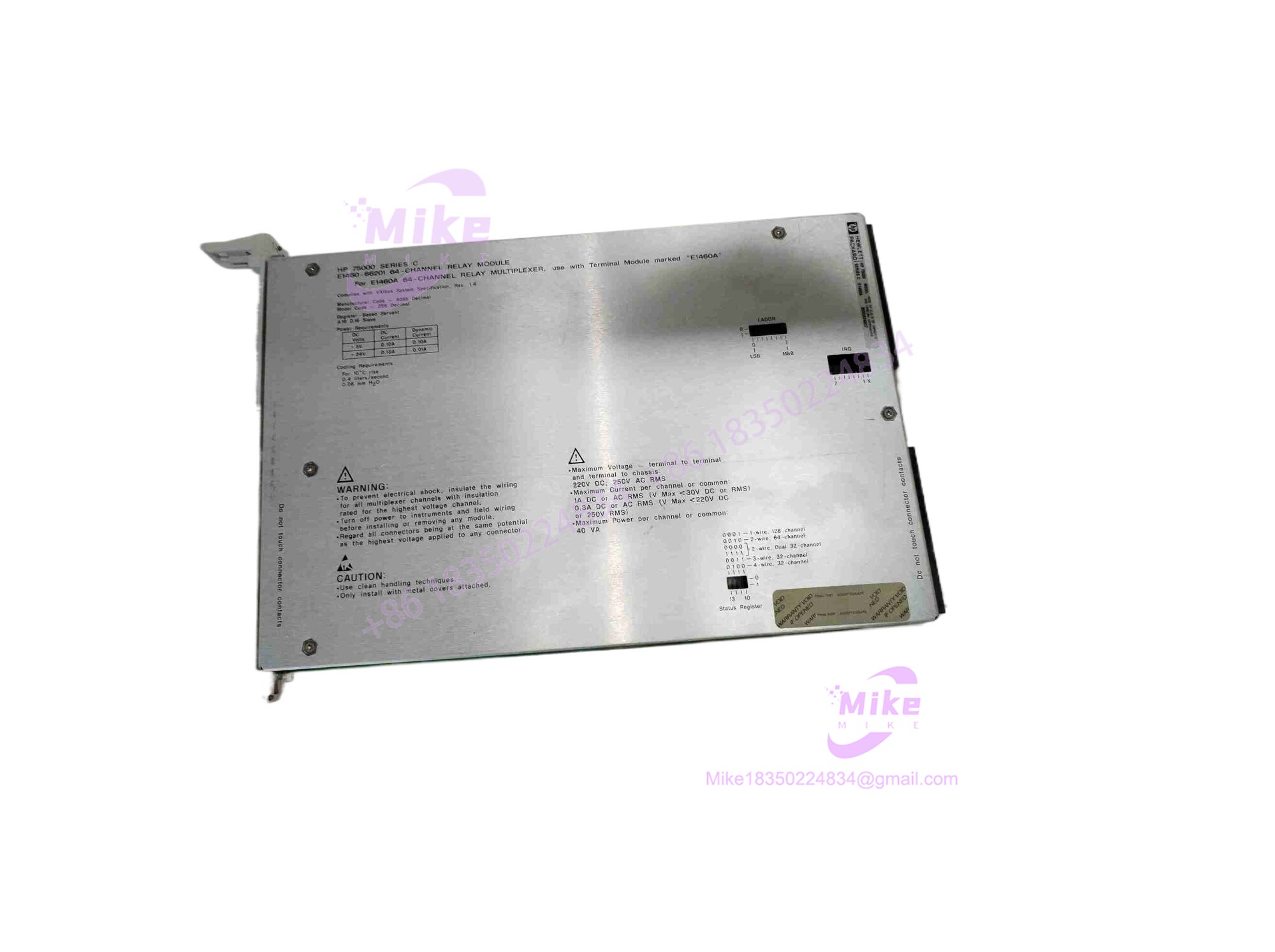
E1460A
Key Technical Specifications
| Parameter | Specification |
| Series | Agilent / HP VXIbus Modular Switching |
| Model / Part Number | E1460A |
| Form Factor | C-Size, 1-slot VXIbus module |
| Switching Capacity | 64 2-wire channels (software configurable to 32 4-wire channels) |
| Max Switching Voltage / Current | Typically up to 250 VDC/VAC peak, 1 A switch current (application dependent) |
| Relay Type | Electromechanical armature relays |
| Scanning Capability | Built-in scan list memory and hardware trigger support for high-speed automated sweeps |
| Terminal Connection | Detachable front-panel terminal block / screw-terminal interface |
Field Engineer’s Pitfall Guide
- WARNING: Hot-Switching Inductive Loads. Switching high DC voltages or large inductive loads while current is actively flowing will pit and weld the electromechanical relay contacts, permanently ruining the channel.
- WARNING: Over-Current Relay Burnout. Exceeding the maximum current rating (typically 1 A per channel) will cause thermal overload, fusing internal traces or destroying the relay coils.
- WARNING: Terminal Block Wiring Errors. Mismatching wire connections on the detachable front terminal block during a swap can short power supplies or send high voltage into sensitive DMM measuring inputs.
- Field Anecdote: I remember an automated production line halting because an E1460A module kept throwing measurement errors, traced back to a technician who had hot-switched a high-inductive solenoid load, fusing three channels shut.
QA & Testing SOP
- Visual & Origin Verification: Inspect the front terminal block, outer metal shield, and rear VXI DIN connector pins for bent pins, corrosion, or burnt traces, and verify original Agilent nameplate data.
- Live Test Bench Environment: Install the module into a certified C-size VXI mainframe running VISA-compatible control software and a Digital Multimeter (DMM) test channel.
- Continuity & Relay Verification: Execute command scripts to cycle each of the 64 relay channels individually, measuring contact resistance using a precision DMM to ensure zero stuck or high-resistance contacts.
- Anti-Static & Protective Packaging: Enclose the module in anti-static shielding and pack it inside high-density structural foam to protect the protruding terminal blocks and rear pins during transit.
Technical FAQ
What software is used to control the Agilent switch module?
The module is controlled using standard VISA/SICL command libraries and VXI plug-and-play instrument drivers integrated into test environments like LabVIEW, LabWindows/CVI, or TestExec.
Can the be configured for 4-wire measurements?
Yes. Through software configuration commands, the 64-channel 2-wire layout can be reconfigured into 32 channels of 4-wire switching, commonly used for precise four-terminal resistance measurements.
Is the still actively manufactured?
No. The is obsolete and discontinued by Keysight Technologies. Certified refurbished units and replacement terminal blocks are available through specialized test and measurement suppliers.
What causes relay click failure or unresponsiveness on specific channels?
Unresponsiveness is typically caused by a blown driver circuit on the control board, a loose internal ribbon cable, or physical wear/welding of the individual mechanical relay contacts from over-current usage.





