


Description
Absolute Process API4380GD | Field-Configurable Analog Signal Conditioner
Product Introduction
When ground loops or common-mode noise threaten to corrupt critical PLC and DCS sensor inputs, standard pass-through wiring falls short. The Absolute Process Instruments API4380GD is not a passive splitter; it is a high-accuracy, field-configurable DC-to-DC signal isolator engineered to clean up erratic process loops on the fly. Designed around an accessible octal-socket plug-in chassis, this module lets instrumentation techs map hundreds of input and output combinations using external slide and rotary switches without messing with component-level jumpers.
Operating right at the frontline of control panels and marshaling cabinets, the unit combines robust optical isolation with built-in LoopTracker LEDs to give instant visual feedback on loop health—though your mileage may vary depending on local cabinet thermal density and surrounding electromagnetic interference. It bridges disparate hardware signals seamlessly while keeping delicate controller cards safe from high-voltage spikes.
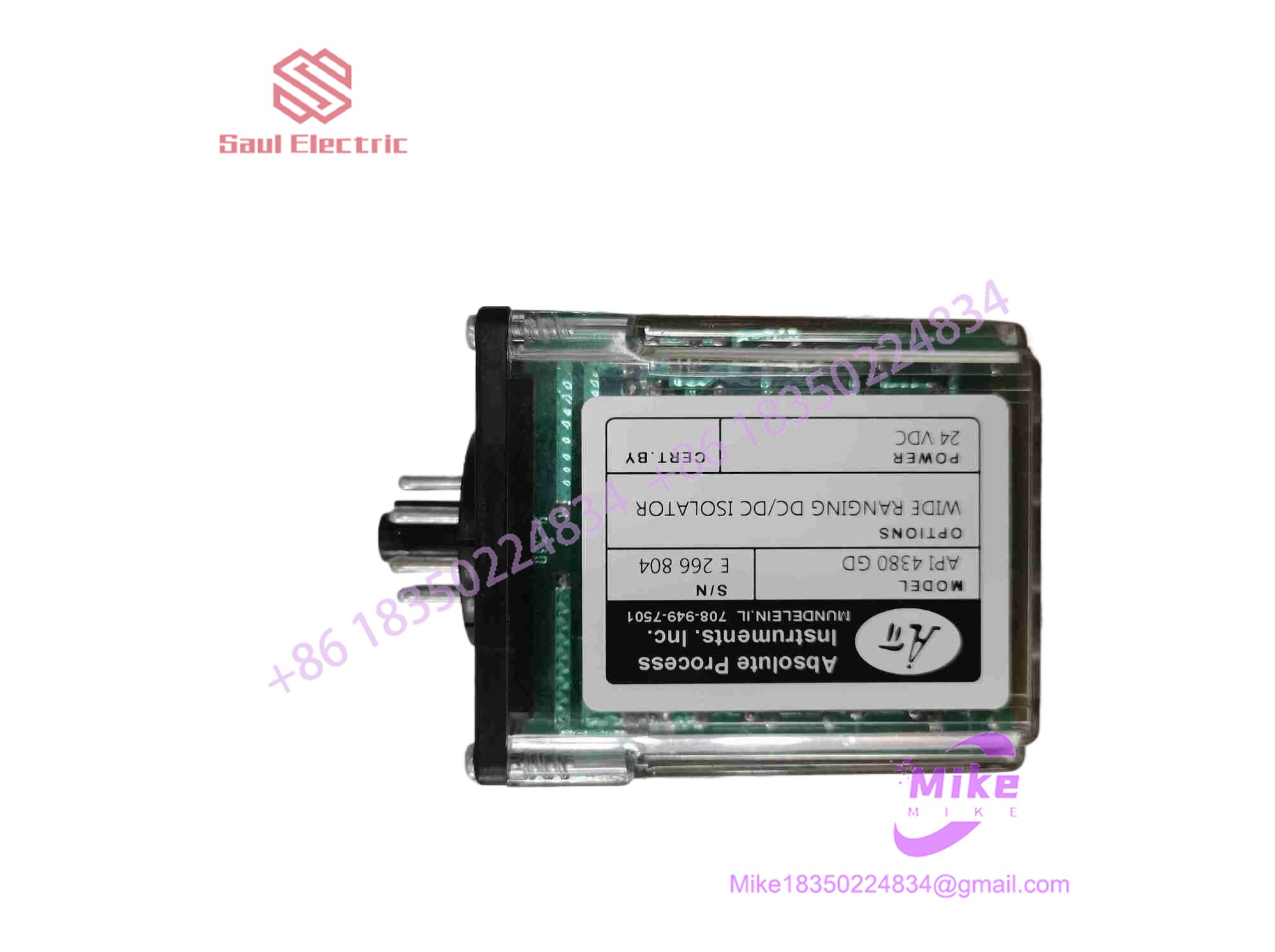
API4380GD
Key Technical Specifications
| Parameter | Specification |
| Manufacturer | Absolute Process Instruments (API) |
| Model Designation | API 4380 GD (Includes 9-30VDC low-voltage power variant) |
| Input Ranges | Field switch-selectable voltage (0–50mVDC to 0–10VDC, bipolar) and current (0–1mA to 0–20mA) |
| Output Ranges | Field switch-selectable voltage (0–1V to 0–10VDC) and current (0–2mA to 0–20mA, 4–20mA) |
| Isolation Rating | 2000 VRMS minimum (Full 3-way: Input to Output to Power) |
| Supply Voltage (‘D’ Option) | 9 to 30 VDC power input |
| Diagnostic Indicators | Dual LoopTracker LEDs (Green for input, Red for output scaling intensity) |
| Special Features | Front-accessible functional test button (adjustable 0–100% output simulation) |
| Mounting / Enclosure | Industry-standard 8-pin octal socket (API 008 / API 008 FS) for DIN rail or panel mount |
| Operating Temperature | -10°C to +60°C continuous industrial span |
Application Scenarios & Pain Points
- Waste Treatment Facility Ground Loop Elimination:
- Without API4380GD: Shared earth references between remote pH sensors and a central PLC caused erratic analog fluctuations of up to 2mA, triggering false high-level alarms.
- With API4380GD: Full 3-way 2000V isolation completely broke the ground loop path, instantly smoothing out the process variable trendline.
- Retrofitting Legacy Recorder Loops: A manufacturing plant in the Midwest needed to scale a non-standard 0–50mV sensor output into a modern 4–20mA DCS card without replacing the legacy primary transmitter—solved natively by dialing the unit’s onboard rotary selector switches.
- High-Vibration Compressor Skids: Mounted inside a heavily vibrating local control enclosure, the plug-in module’s secure octal socket design—when locked down with a hold-down spring—maintains firm pin contact without backing out under continuous mechanical resonance.
QA & Live Testing SOP (Trust Signal)
We treat signal conditioning and isolation hardware with strict diagnostic verification. Before an API4380GD module is cleared for deployment, it goes through a bench validation routine:
- Switch & Dial Integrity Check: Mechanically cycled and checked all external DIP/rotary range selector switches for crisp detents and zero oxidation resistance.
- Power & LoopTracker Validation: Energized via a regulated 9–30VDC bench supply to verify that the dual LoopTracker LEDs scale properly in intensity relative to applied inputs.
- Multi-Point Span Calibration: Injected known mV/mA steps using a precision calibrator across the input terminals while tracking output linearity on a 6.5-digit multimeter to ensure accuracy remains well within the rated ±0.1% of span limit.
- Functional Test Button Operation: Pressed the front-panel test button to confirm the output overrides normal inputs and accurately drives to the potentiometer-preset simulation level.
- Protective Packaging: Dispatched in anti-static protective packaging to prevent static discharge to the internal CMOS isolation barriers.
Field Engineer’s Pitfall Guide
- ❗ Power Variant Confusion: Ensure you verify whether your specific unit has the ‘D’ suffix (9–30VDC) or is a standard AC-powered variant (e.g., 115VAC). Supplying mains AC to a low-voltage DC-powered model will instantly destroy the internal power regulation stage.
- ❗ Socket Pin Alignment: When hot-swapping modules into an 8-pin octal socket, do not angle or force the pins. Misalignment can distort the socket receiver clips, leading to intermittent connection drops under thermal expansion.
- ❗ Switch Setting Verification: Always double-check your rotary and slide switch configurations against the module’s side label table before powering up the loop; an unmapped switch code can result in a pegged or dead output state.
Intent-Driven FAQ
Can I hot-swap the API4380GD module without shutting down the control panel?
Yes, the plug-in octal-socket design allows you to pull and replace the module live without rewiring power or signal cables, provided you account for any live loops feeding final control elements.
What does the ‘D’ designation mean in the part number?
The ‘D’ option specifies that the unit is powered by a low-voltage DC source (9 to 30 VDC) rather than standard AC line voltages like 115VAC or 230VAC.
How do I configure the input and output ranges?
Range scaling is done entirely in the field using the external rotary and slide switches located on the housing, matching the configuration lookup tables printed directly on the unit casing.
What is the purpose of the front-panel functional test button?
It forces a fixed, potentiometer-adjustable output level (independent of what the sensor is actually sending). This allows technicians to test downstream PLC/DCS input channels during loop checkouts without needing to manipulate field process variables.
Does this isolator supply power to two-wire transmitters?
Yes, it features a built-in input loop power supply capable of driving standard 2-wire transmitters, minimizing the need for auxiliary power distribution blocks in the panel.





