

Description
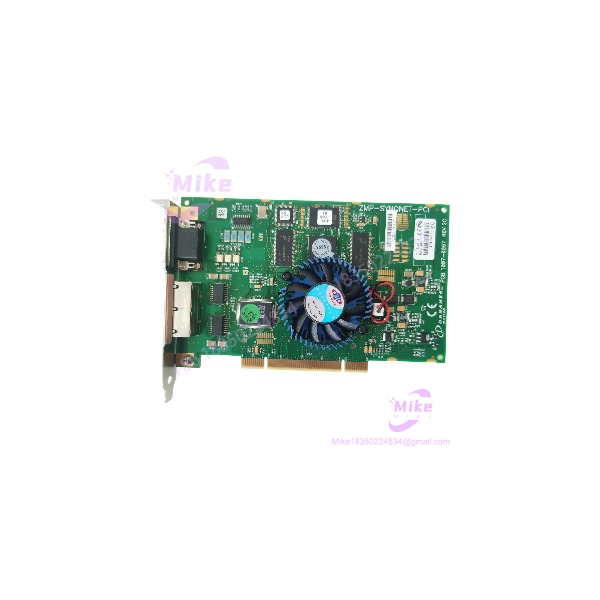
Danaher ZMP-SYNQNET-PCI | 32-Axis SynqNet Motion Controller Board
Dynamic Product Introduction
In advanced packaging lines, high-speed semiconductor assembly cells, and multi-axis automated machinery distributed under the Danaher Motion and Kollmorgen product umbrellas, relying on host PC operating systems to handle real-time motion timing introduces jitter and tracking errors. When servo update loops lag by even a fraction of a millisecond, precision coordinated paths degrade. The Danaher/MEI ZMP-SYNQNET-PCI motion control card solves this latency bottleneck by executing dedicated motion firmware directly on an onboard 64-bit PowerPC RISC processor.
Designed to interface with industrial PC backplanes via a 32-bit Universal PCI slot, the ZMP-SYNQNET-PCI acts as the master node for a 100 Mbps deterministic SynqNet ring. It orchestrates up to 32 motion axes and 34 network nodes, transmitting motion commands, drive parameters, and I/O states over a self-healing optical/copper network. (Honestly, running all real-time trajectory math locally on the board’s onboard CPU ensures that Windows host applications can execute complex graphical user interfaces or database queries without ever dropping a servo tick.) Equipped with dual RJ45 network ports and an HD-15 auxiliary user connector, the ZMP-SYNQNET-PCI delivers robust multi-axis synchronization—though maintaining clean network operation strictly requires using double-shielded industrial Ethernet cabling.
ZMP-SYNQNET-PCI
Key Technical Specifications
- Manufacturer & Platform: Danaher Motion / Motion Engineering Inc. (MEI) / Kollmorgen / ZMP Series
- Hardware Model / Catalog Code: ZMP-SYNQNET-PCI / 1007-0097 / ZMP-SynqNet-PCI-RJ
- Host Bus Interface: 32-bit Universal PCI (33 MHz / 66 MHz bus speed, 3.3V and 5V signaling compatible)
- Onboard Processor: 64-bit PowerPC RISC processor dedicated to real-time motion generation
- Maximum Axis Capacity: Controls up to 32 independent motion axes (servo or stepper)
- Maximum SynqNet Nodes: Up to 34 physical network nodes (drives, remote I/O modules, ancillary hardware)
- Communication Network: SynqNet deterministic 100BT physical layer (100 Mbps data transfer rate, ring topology)
- Front Panel Connectors:
- 2 x RJ45 ports for SynqNet ring communication (IN / OUT)
- 1 x High-Density 15-pin (HD-15) female connector for auxiliary user I/O and high-speed position capture
- Software API Support: MEI C/C++ API, RapidCode, Danaher Motion programming environments, Windows drivers
- Power Requirements: +5 VDC supplied directly from the host PCI bus slot
- Operating Ambient Temperature: 0°C to +55°C (32°F to 131°F) continuous operational range
Global Sourcing & Live-Test SOP (Transparency Core)
Procuring secondary-market or legacy Danaher Motion hardware requires strict electrical, bus communication, and real-time ring validation before installing boards into production PC chassis. Every ZMP-SYNQNET-PCI board entering inventory undergoes a rigorous five-stage bench test protocol:
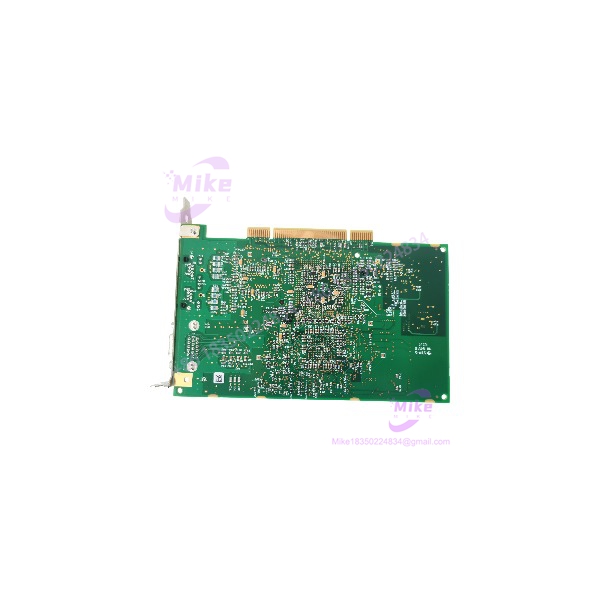
- Inbound Visual & Bus Inspection: Part numbers, serial tracking tags, and PCB revision codes (e.g., 1007-0097) are cross-referenced against Danaher/MEI factory ledgers. We inspect the 120-pin PCI gold edge connector for oxidation or wear, verify front-panel RJ45 locking tabs, and check surface-mount components for thermal stress.
- Host PC & Bus Enumeration: The board is installed into an industrial test PC running 32-bit/64-bit Windows. Low-level PCI scans verify memory-mapped I/O assignments, DMA channel allocation, and initial firmware handshakes across the host bus.
- SynqNet Ring Network Simulation: The dual RJ45 ports are integrated into an active SynqNet test ring featuring compatible Danaher/Kollmorgen drives and remote I/O nodes. We establish a 100 Mbps loop, confirming node auto-discovery, topology mapping, and system clock synchronization.
- Multi-Axis Motion & Stress Testing: Using MEI RapidSetup or Danaher Motion diagnostics, we command synchronized 32-axis trajectory profiles (trapezoidal, S-curve, and PVT streaming) across simulated drive loads. Network communication jitter is measured with an oscilloscope to ensure sub-microsecond stability.
- Hot-Replace & Fault Recovery Test: While executing motion profiles, we simulate a line break in the SynqNet ring to confirm the board’s self-healing fault-tolerant rerouting mechanism operates without dropping control packets or tripping hard axis faults.
- Final Prep: Non-volatile configuration tables are cleared, RJ45 ports are fitted with protective dust plugs, and the ZMP-SYNQNET-PCI board is sealed in ESD anti-static moisture-barrier packaging.
The Field Engineer’s Pitfall Guide
❗ Breaking SynqNet Ring Topology Rules (IN vs OUT Cable Routing): SynqNet relies on a dual-ring fault-tolerant loop architecture. Connecting the OUT port of the ZMP-SYNQNET-PCI card directly into its own IN port, or crossing node patch cables improperly, prevents network initialization and triggers persistent hardware timeout errors. Always route from Controller OUT \rightarrow Node 1 IN \rightarrow Node 1 OUT \rightarrow Node 2 IN … \rightarrow Controller IN.
❗ Incorrect Host PC Boot Sequence During Network Initialization: Because the onboard PowerPC CPU boots its firmware independently when PCI slot power (+5V) is applied, powering on remote SynqNet servo drives after the host IPC has finished booting can prevent the ZMP card from discovering downstream nodes. Always power up downstream servo drives and I/O nodes prior to, or simultaneously with, the host PC.
❗ Using Unshielded Ethernet Patch Cables in High-EMI Enclosures: Standard commercial unshielded (UTP) Ethernet cables should never be used for SynqNet wiring. High dv/dt PWM noise from adjacent servo drive power leads induces severe EMI into unshielded lines, corrupting data packets and triggering network safety ring breaks. Always use industrial double-shielded (STP/FTP) Category 5e/6 cables with grounded metal RJ45 connector shells.
Intent-Driven FAQ
Q: What is the primary difference between Danaher’s ZMP-SYNQNET-PCI and older XMP-SYNQNET boards? The ZMP series features a higher-performance onboard PowerPC processor, increased axis and node density, faster processing clock rates, and enhanced onboard memory access compared to legacy XMP-SynqNet boards. However, user application software developed with MEI/Danaher API libraries maintains cross-compatibility between both board families.
Q: Does the ZMP-SYNQNET-PCI card require a Real-Time Operating System (RTOS) like RTX or VxWorks on the host PC? No. Because all critical real-time motion trajectory generation, PID servo loops, and SynqNet network communications execute entirely on the ZMP card’s onboard PowerPC CPU, the host PC can run standard desktop Windows without requiring a dedicated third-party RTOS.
Q: What function does the front-panel HD-15 connector serve on the ZMP-SYNQNET-PCI board? The HD-15 connector provides high-speed auxiliary hardware I/O, including dedicated position capture/probe inputs and trigger outputs. These inputs bypass network latency, allowing sub-microsecond position latching directly onto the card for high-speed sensor or optical registration marks.
Q: Can I use the ZMP-SYNQNET-PCI card in a standard PCI Express (PCIe) slot? No. The ZMP-SYNQNET-PCI is a 32-bit parallel PCI card designed for traditional PCI expansion slots. If your industrial PC only contains PCI Express slots, you must use the PCIe equivalent variant (such as the QMP-SYNQNET-PCIe series).
Q: How does the “HotSwap” capability work on a SynqNet network driven by the ZMP card? SynqNet allows a failed downstream node (such as an individual servo drive or I/O block) to be power-cycled or physically replaced without dropping host communication or interrupting active motion control on the remaining unaffected nodes in the ring. The ZMP controller automatically detects node restoration and re-integrates it into the network.





