

Description
Emerson Epro PR6423/00R-000 | Eddy Current Probe, New In Stock
Architect’s Product Breakdown
The Emerson Epro PR6423/00R-000 functions as an industrial eddy-current proximity sensor engineered to capture sub-micron mechanical movements inside critical rotating equipment like steam turbines, large centrifugal compressors, and boiler feed pumps. Built specifically with a reverse-mount configuration, this transducer mounts through specialized housing fixtures where standard forward-threading options are physically restricted. By measuring the high-frequency electromagnetic field interaction between the probe tip and the metallic shaft surface, it delivers continuous displacement metrics directly to rack-mounted monitoring cards.
Deploying this specific model requires precise gap voltage calibration and careful handling of the attached high-frequency coaxial cable run. Because eddy-current systems rely on strict impedance matching, replacing a damaged probe requires ensuring the extension cable length and signal driver electronics match the exact calibration curve. Plant engineers must also ensure proper physical isolation from stray electromagnetic fields and high-temperature pockets inside bearing housings to prevent long-term thermal drift and false machinery trips.
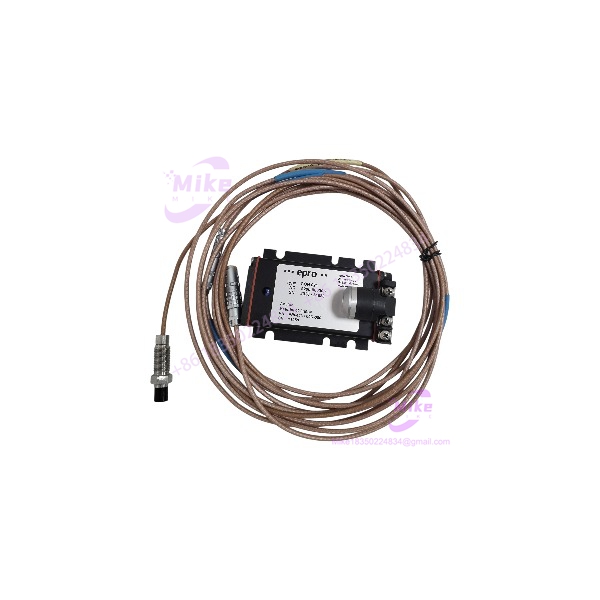
PR6423/00R-000
Key Technical Specifications
| Parameter | Specification Details |
| Sensor Tip Diameter | 8 mm |
| Mounting Style | Reverse mount configuration |
| Sensitivity | 8 V/mm (203.2 mV/mil) |
| Linear Measurement Range | 2.0 mm (nominal linear operating span) |
| Supply Voltage | –24 VDC system power via driver |
| Frequency Response | 0 Hz to 10,000 Hz |
| Probe Tip Material | PEEK (Polyether Ether Ketone) |
| Operating Temperature | -35°C to +180°C |
| Connector Type | Lemo high-frequency plug |
| Cable Length | Integrated 1-meter coaxial lead |
Field Engineer’s Pitfall Guide (Unique Value)
- Coaxial Impedance Alterations: Splicing or modifying the length of the coaxial cable between this probe and the signal converter alters total circuit capacitance and ruins calibration accuracy. I once spent an entire turnaround shift chasing erratic vibration spikes on a gas turbine, only to find a technician had spliced an incompatible length of generic coax into the line.
- Incorrect Initial Gap Setting: Failing to set the mechanical resting gap to the specified nominal voltage (typically -12 VDC) pushes the transducer out of its linear operating window. This causes signal clipping during peak vibration excursions under full load.
- Thread Sealing Compound Contamination: Using liquid thread-locking compounds or RTV silicone near the probe tip can outgas or foul the PEEK face, introducing measurement distortion and erratic DC voltage shifts.
QA & Testing SOP (Transparency)
- Visual & Origin Verification: Inspection of OEM factory seals, serial number traceability, PEEK tip integrity, and Lemo connector pin alignment.
- Live Test Environment: Bench testing the sensor on a calibrated micrometer target rig powered by a regulated -24 VDC source and matching signal converter driver card.
- Diagnostics & Calibration: Verifying static gap voltage outputs, dynamic linearity across the full 2 mm measurement range, and frequency response stability.
- Documentation & ESD Packaging: Archiving calibration verification reports, capping the sensor tip, and sealing the unit in static-dissipative shielding packaging.
Technical FAQ
- Can I use this probe with a signal converter from a different manufacturer? No. Eddy-current systems are precisely matched as a complete circuit loop consisting of the probe, extension cable, and driver card. Mixing brands destroys measurement linearity and calibration validity.
- What is the significance of the reverse-mount configuration on this model? The reverse-mount design allows the probe to be secured from the inside of a mounting bracket or bore where external threading access is physically blocked by surrounding machine casing.
- Does lubricating oil inside the bearing housing interfere with the measurement? Lubricating oil has minimal impact on eddy-current magnetic fields compared to metallic surfaces, though extreme aeration or contamination can occasionally cause minor signal noise.
- How is the target material composition factored into calibration? Factory calibrations are set against standard 42CrMo4 steel targets; alternative shaft metallurgy requires customized sensitivity offsets in the monitoring system.





