

Description
Emerson Epro PR6423/003-030-CN | 8mm Shaft Vibration Sensor, In Stock
Architect’s Product Breakdown
The Emerson Epro PR6423/003-030-CN probe operates as a primary sensing element engineered to capture microscopic dynamic displacements and physical position changes inside high-speed rotating equipment, including steam turbines, boiler feed pumps, and centrifugal gas compressors. By generating a high-frequency electromagnetic field at its PEEK-encapsulated tip, the probe detects air-gap variations between the sensor face and the target shaft. The suffix designation indicates an open cable end (“CN” configuration without a pre-installed Lemo connector), allowing field engineers to terminate the coaxial lead directly into explosion-proof terminal boxes or specialized conduit glands.
Deploying the PR6423/003-030-CN requires precise attention to electrical impedance and overall loop capacitance limits. Because eddy-current systems rely on fine-tuned high-frequency resonant circuits, the integrated 3.0-meter coaxial cable forms an active part of the signal calibration loop. Field technicians must ensure the open end is stripped and terminated cleanly into matched terminal blocks without altering cable length or introducing stray resistance, preventing signal reflection and high-frequency noise interference from corrupting the vibration spectrum.
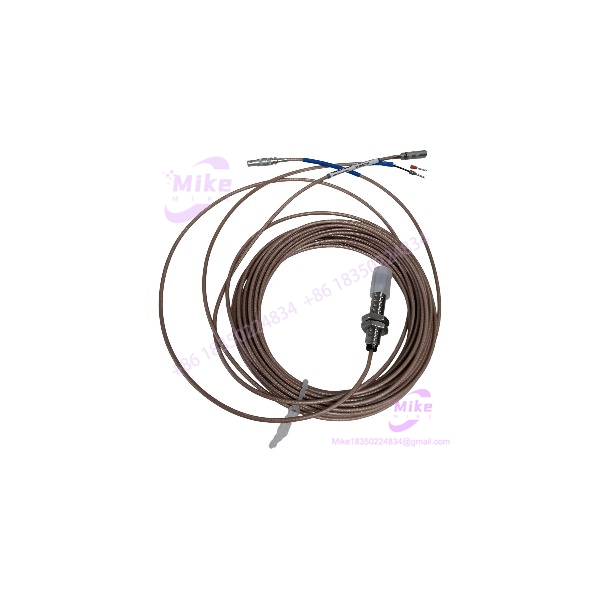
PR6423/003-030-CN
Key Technical Specifications
| Parameter | Specification Details |
| Sensor Tip Diameter | 8 mm PEEK face |
| Thread Specification | M10 x 1 standard pitch |
| Integrated Cable Length | 3.0 meters high-frequency coaxial lead |
| Termination Style | CN (Open cable end / stripped leads) |
| Sensitivity / Scale Factor | –8 V/mm (–203.2 mV/mil) nominal |
| Linear Measurement Span | 2.0 mm operating window |
| Nominal Static Gap Voltage | –12 VDC (center of linear range) |
| Frequency Response | 0 Hz to 10,000 Hz (-3 dB bandwidth) |
| Operating Temperature | –35°C to +180°C (probe head and cable) |
| Enclosure Protection | IP66 rated assembly when properly installed |
Field Engineer’s Pitfall Guide (Unique Value)
- Improper Terminal Strip Connections on CN Leads: Splicing or using loose screw terminals to join the open cable ends of the PR6423/003-030-CN to field wiring introduces contact resistance and micro-capacitance shifts. I once spent an entire graveyard shift troubleshooting a false high-vibration trip on an induction blower, only to discover a technician had crimped non-insulated butt splices onto the coaxial shield, injecting ground hum into the signal converter.
- Coaxial Cable Shortening: Trimming or cutting the integrated 3.0-meter cable to neatened cabinet routing will alter the calibrated total capacitance. This shifts the scale factor curve and ruins measurement accuracy across the linear span.
- Shield Ground Loops at Field Boxes: Grounding the coaxial shield lead at both the machine junction box and the driver module chassis creates earth loops. Always maintain floating shield isolation at the probe gland and tie to signal ground strictly at the signal converter or monitoring rack end.
QA & Testing SOP (Transparency)
- Visual & Origin Inspection: Verification of OEM packaging seals, thread structural integrity, PEEK tip encapsulation, and open cable lead condition.
- Live Test Environment: Bench testing the PR6423/003-030-CN probe terminated into a matching test driver card on a precision micrometer calibration fixture powered by a regulated -24 VDC bench supply.
- Diagnostics & Calibration Verification: Checking static gap output voltage, verifying dynamic sweep response across the 2.0 mm linear range, and inspecting signal noise floor levels.
- Documentation & ESD Packaging: Logging test calibration data, capping the thread housing, and sealing the unit inside static-shielding bags with custom protective packing.
Technical FAQ
- What does the “CN” suffix in the PR6423/003-030-CN model number signify? The “CN” suffix indicates an open cable end configuration without a Lemo plug, designed for direct termination into terminal strips or custom junction box enclosures.
- Can I connect the open cable ends directly to a standard PLC 4-20 mA input module? No. The PR6423/003-030-CN probe produces raw high-frequency impedance shifts that require connection to a matching signal converter (such as the CON021 driver) to output a calibrated voltage or current signal.
- Does lubricating oil inside the bearing housing interfere with the measurement? No, non-conductive mineral or synthetic lubricating oil spray does not disrupt the eddy-current electromagnetic field generated by the sensor.
- What happens if my target shaft is made of 304 stainless steel instead of carbon steel? Standard factory calibration is tuned against 42CrMo4 carbon steel targets; alternative metallurgy changes magnetic permeability, requiring custom scale factor adjustments inside your monitoring system hardware.





