


Description
B&R 8MSA4M.E3-86 | Size 4 EnDat Multiturn Encoder
Dynamic Product Introduction
The 8MSA4M.E3-86 is designed for motion control tasks where standard resolver feedback isn’t precise enough. Built into a Size 4 frame (~105mm flange) with a medium rotor length (“M” variant), this motor balances low inertia with a robust 5.3 Nm continuous stall torque output.
The defining highlight of this configuration is its E3 variant absolute optical multiturn encoder (EnDat interface). Unlike resolver models that require homing routines upon power-up, the absolute encoder tracks exact multi-revolution position data across power cycles. When wired to an ACOPOS inverter, the digital EnDat bus provides sub-micron position accuracy and high immunity to electrical noise during rapid dynamic changes.
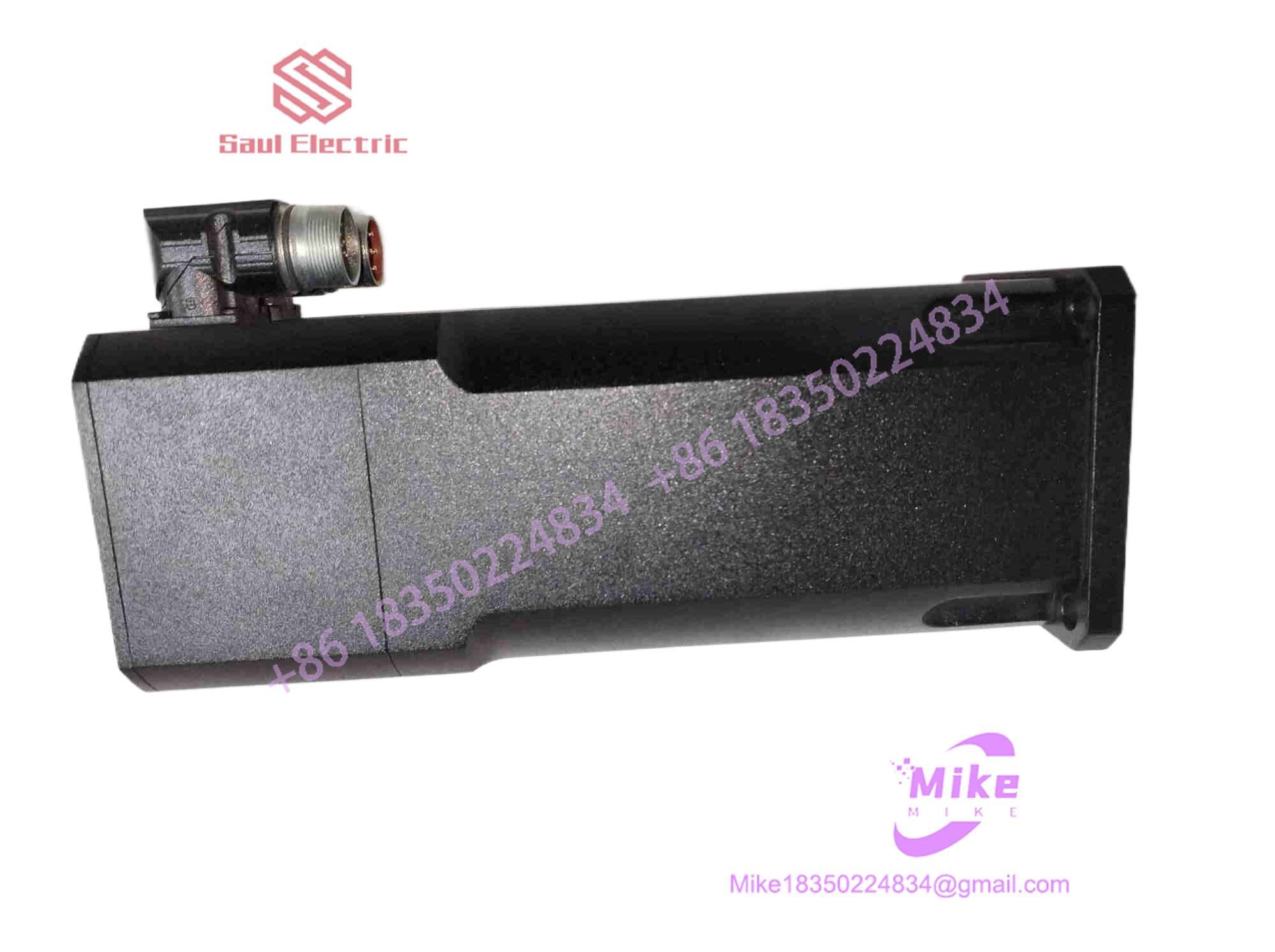
8MSA4M.E3-86
Key Technical Specifications
| Parameter | Specification | Field Note / Operational Limit |
| Flange Size | Size 4 (~105mm Flange) | Compact footprint for mid-range structural axes |
| Stall Torque (M_0) | ~5.30 Nm | Continuous torque rating at \Delta T = 100 K |
| Peak Torque (M_{\max}) | ~21.2 Nm | Short-duration acceleration transient limit |
| Feedback System | Absolute Multiturn Optical Encoder (E3 / EnDat) | Retains exact shaft coordinates across power outages without homing |
| Protection Rating | IP65 Standard | Casing sealed against industrial dust and splash liquids (shaft seal ring fitted) |
| Connection Style | SpeedTEC / Intercontec Connectors | Dual 90-degree rotatable circular connectors |
| Overall Length (K_0) | ~221 mm (Encoder Housing) | EnDat option extends motor length vs. resolver models (~185 mm) |
| Cooling Method | Natural Convection | Requires a minimum 40mm surrounding air gap for heat dissipation |
| Thermal Protection | Integrated PTC / KTY Sensor | Monitored via encoder feedback line directly to ACOPOS drive |
Global Sourcing & Live-Test SOP (Transparency Core)
Replacing precision optical encoder motors requires strict testing before deployment. Installing a motor with damaged glass encoder disks or bad bearing alignment leads to position drops and drive faults. Every unit undergoes a rigorous verification process:
- Inbound Mechanical Inspection:
We clamp the shaft under digital indicators to confirm radial and axial runout remain within factory spec (<0.015mm). Nameplates are checked against B&R build records to catch relabeled hardware.
- ACOPOS Bench Simulation Setup:
The unit is coupled to an authentic ACOPOS servo drive running B&R Automation Studio.
- Diagnostic Test Execution:
- EnDat Serial Data Handshake: We verify that the drive reads electronic motor nameplate parameters directly from the encoder’s internal memory without communication errors.
- Multiturn Memory Cycle: Power is cycled while manually turning the shaft to ensure the absolute multiturn count tracks accurately without position drift.
- Dynamic Load Run: The motor performs multi-axis velocity profiling to test thermal stability, bearing acoustics, and torque response at high speed.
- Dielectric Megger Test: A 1000V DC test across stator phases and ground ensures full insulation integrity.
- Final Packaging:
Shaft extensions receive protective caps and anti-rust film. The complete unit is sealed in static-shielding wrap and packed in high-density foam casing.
The Field Engineer’s Pitfall Guide
- ❗ Never Swap Resolver and EnDat Cables Direct-to-Drive:
The
E3variant uses high-speed digital serial lines for the EnDat interface. Wiring an EnDat motor into a resolver-configured ACOPOS plug (likeR0) can damage the drive’s encoder processing card or burn out internal logic chips. Always verify cable pinouts and drive plug cards beforehand. - ❗ Protect the Optical Glass Disk from Impact:
Unlike rugged electromagnetic resolvers, EnDat encoders contain a precision glass scale disk inside the rear housing. Banging couplings or pulleys onto the shaft with a hammer will fracture the glass disk, triggering instant
Encoder Line Error 7021on the ACOPOS drive. - ❗ Mismatched Hardware Tree in Automation Studio:
When replacing an
R0motor with anE3motor, updating physical wiring isn’t enough. You must update the motor feedback type in the Automation Studio project tree from Resolver to EnDat Encoder. Failing to do so prevents drive initialization and blocks motor enablement.
Intent-Driven FAQ
What does the “E3” code mean in 8MSA4M.E3-86?
The E3 designation indicates that the motor is equipped with an absolute optical multiturn encoder utilizing the Heidenhain EnDat interface. It provides precise absolute position tracking over thousands of shaft revolutions.
Why is the frame length longer on the 8MSA4M.E3 compared to the 8MSA4M.R0?
Optical EnDat encoder modules (E3) require a larger rear enclosure to house the optoelectronic sensing board and multiturn gear mechanism (~221 mm) compared to standard analog resolver units (~185 mm).
Will an ACOPOS drive automatically detect the motor parameters?
Yes. B&R motors with EnDat absolute encoders store factory parameters—including current limits, winding constants, and temperature thresholds—directly on an internal EEPROM. The ACOPOS drive reads this data automatically upon startup.
Can I run an 8MSA4M.E3-86 without homing the machine on startup?
Yes. Because it uses an absolute multiturn encoder, the motor remembers its exact position even after complete power loss, eliminating the need for homing limit switches.
How can I verify that a replacement 8MSA4M.E3 unit is genuine and unused?
Inspect the flange face, shaft keyway, and SpeedTEC connector pins. Unused factory stock shows no bolt clamping marks on the mounting holes, zero keyway wear, unmarred gold connector pins, and original protective shaft caps in place.





