


Description
B&R 8LSA55.EB030D200-1 | Size 5 Frame 12.5 Nm Servo
Dynamic Product Introduction
Stepping into a processing line driving heavy ball screws or rotary tables usually reveals where standard motors hit their limits—thermal throttling under cyclic load ramps. B&R engineered the 8LSA55.EB030D200-1 specifically to deliver high continuous torque without blowing through thermal headroom. Delivering 12.5 Nm of stall torque from a compact Size 5 housing, this motor handles high peak acceleration demands up to 41.4 Nm without risking stator coil degradation.
What makes this unit a workhorse for modern functional safety architectures is its EB inductive multi-turn encoder configuration. Unlike delicate glass-scale optical encoders that shatter under machine vibration or fog up when oil seals seep, inductive sensing uses electromagnetic field variation. That means your position feedback stays rock-solid even in high-vibration stamping press feeder lines or harsh machining bays. When wired to ACOPOS drives, the serial protocol feeds drive parameters straight into Automation Studio, keeping commissioning times minimal.
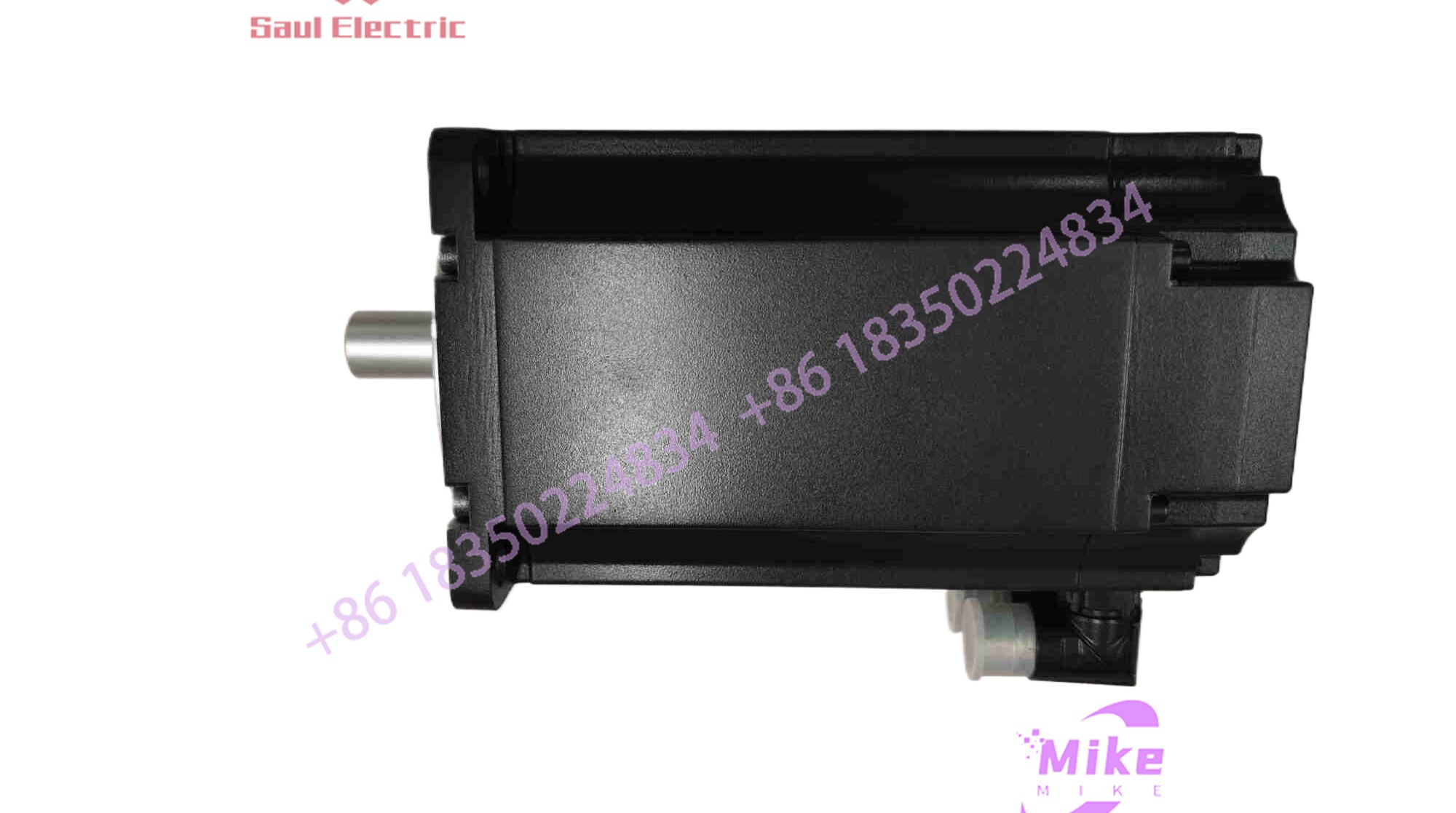
8LSA55.EB030D200-1
Key Technical Specifications
| Parameter | Specification | Field Note / Operational Limit |
| Nominal Speed | 3000 RPM | Maximum continuous velocity at nominal DC bus voltage |
| Stall Torque (M_0) | 12.5 Nm | Continuous holding torque rating (\Delta T = 100 K) |
| Peak Torque (M_{\max}) | 41.4 Nm | Maximum transient acceleration torque burst |
| Nominal Output Power | ~3.64 kW | Mechanical shaft power output at 3000 RPM |
| Feedback System | Inductive Multi-Turn (EB Encoder) | High vibration tolerance, serial position protocol |
| Rotor Inertia | ~8.19 kg·cm² | Mid-inertia core balancing dynamic response and load matching |
| Brake Option | Integrated Holding Brake (~15 Nm) | Holds axis stationary when power stage drops out |
| Connection Style | Dual Swivel Connectors (SpeedTEC) | Right-angle rotatable circular quick-lock connectors |
| Weight | ~10.4 kg (without brake) | Standard Size 5 frame mounting footprint (142mm flange) |
Global Sourcing & Live-Test SOP (Transparency Core)
Buying replacement industrial servo hardware from secondary stock requires absolute mechanical and electrical verification. You cannot afford to install a motor with hidden bearing pitted races or corrupted serial EEPROMs. Here is our exact quality control protocol before any unit leaves our ESD workspace:
- Inbound Mechanical & Documentation Audit:
We measure shaft radial runout and axial float using digital dial gauges to ensure tolerances remain within factory limits. Serial tags are checked against OEM records to verify authentic manufacturing origin.
- ACOPOS Test Stand Integration:
The motor mounts directly to an authentic test fixture interfaced with an ACOPOS 1090 drive and an Automation Studio test rack.
- Diagnostic Test Execution:
- Encoder & Safety Handshake Validation: We query the EB inductive encoder via serial protocol, checking for zero frame transmission errors and verifying auto-population of motor winding parameters in the drive software.
- Full-Load Thermal & Dynamic Profile: The motor executes a 3-hour cyclic velocity test reaching 3000 RPM under loaded conditions, tracking real-time winding temperature rise via internal sensor channels.
- High-Voltage Megger Test: Stator insulation resistance is verified using a 1000V DC megohmmeter across phase-to-phase and phase-to-ground paths.
- Final Shipping Prep:
Shafts are coated with a protective anti-corrosion barrier, fitted with shaft caps, wrapped in static-shielding film, and suspended inside high-density foam shipping boxes.
The Field Engineer’s Pitfall Guide
- ❗ Disconnecting Power Lines While the 24V Holding Brake is Engaged:
If you are swapping an 8LSA55 motor on a vertical axis (like a z-axis gantry), never release the mechanical shaft coupling before securing the axis payload mechanically. The 15 Nm holding brake requires 24V DC to release. If you cut control power before supporting the carriage, gravity will pull the load down the ball screw the instant the motor flange bolts come free—dropping heavy tooling straight onto the bed.
- ❗ Forcing Right-Angle Connector Swivel Under Lock Strain:
The circular SpeedTEC connectors on the 8LSA55 housing swivel to accommodate tight cabinet wire paths. However, attempting to rotate the connector housing while the mating cable plug is locked down creates torsional shear on internal lead wires. Always unscrew and remove the mating cable plug completely before adjusting the connector rotation angle.
- ❗ Ignoring Inductive Encoder Grounding Requirements:
Although inductive EB encoders handle physical shock much better than optical units, they are sensitive to high-frequency common-mode noise generated by ungrounded motor power cables. Running unshielded motor power leads alongside feedback lines without properly earthing the cable shield clamps near the ACOPOS drive creates position bit-stream jitter, throwing periodic communication timeout alarms on the drive.
Intent-Driven FAQ
Will an ACOPOS drive auto-detect the motor parameters for this 8LSA55 model?
Yes. The EB inductive feedback unit contains an embedded electronic nameplate holding all coil data, thermal thresholds, and torque constants. When connected to an ACOPOS drive running B&R motion control blocks, the drive reads these parameters automatically at startup—eliminating manual configuration steps.
What is the advantage of the EB inductive encoder over an optical encoder?
Inductive encoders (like the EB series) utilize magnetic field induction rather than optical glass disks. They are immune to mechanical shock, vibration, oil contamination, and condensation—making them far more reliable in heavy industrial environments like metal forming or wood processing.
Can I replace an 8LSA55.EB030D200-1 with a standard optical encoder motor like an 8LSA55.R series?
Not without altering your drive and PLC configuration. The EB inductive encoder uses a different feedback protocol and pinout interface on the drive side compared to standard resolver (R) or optical EnDat models. Your ACOPOS drive configuration in Automation Studio must match the exact encoder option code.
How do I troubleshoot a motor overtemperature alarm immediately after installation?
First, verify that the feedback connector is fully seated and locked. The internal thermal sensor signal passes through dedicated pins on the feedback connector. An unseated plug or bent pin creates an open circuit, which the ACOPOS drive interprets as an extreme thermal fault above 150^\circC.
How can I confirm if a surplus 8LSA55 motor is genuinely factory unused?
Check three key physical areas: the mounting flange bolt holes, the keyway/shaft surface, and the gold connector pins. Unused units show zero clamping marks or bolt washer rings on the aluminum flange, no shaft keyway wear, pristine gold connector pins without contact scraping, and protective caps intact over the shaft and connectors.





