


Description
Introduction to ABB GDC806A0101 3BHE028761R0101 PQM Peak Demand Management Module
ABB GDC806A0101 3BHE028761R0101 is a PQM (Peak Demand Management) module in ABB’s power automation product line, also known as LXEU1004/GD C806 A101 controller board. Its core function is to synchronize the demand cycle of the user side with the utility billing meter, monitor the level of electricity demand in real time, and automatically perform load shedding operations when the penalty threshold is about to be reached, avoiding additional electricity bills due to peak exceeding limits.
core positioning
The module itself does not collect on-site electrical quantities or directly drive loads, but exists as a “demand management decision-making center” – receiving dry contact signals from utility billing meters, determining whether to initiate a new demand cycle through internal logic judgment, and calculating the difference between the current electricity level and the penalty threshold based on the preset demand target value, driving external relays or contactors to perform orderly load reduction. Unlike ordinary electricity metering modules, GDC806A0101 does not focus on instantaneous power, but on the average demand (Block Interval Demand) within a demand cycle, which is the core parameter of utility billing.
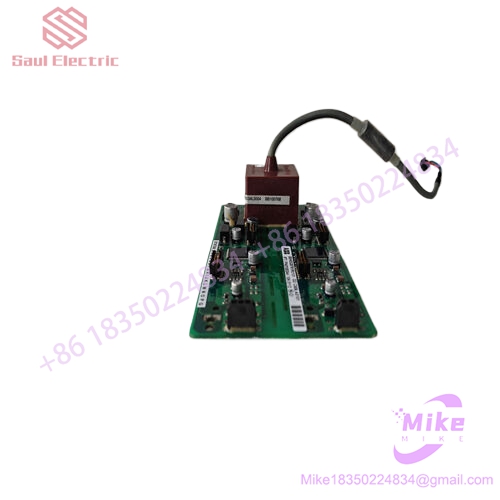
ABB GDC806A0101 3BHE028761R0101 Module
Basic Parameters
Material number: GDC806A0101/3BHE028761R0101
Model: GDC806A0101
Alias: LXEU1004/GD C806 A101
Series: ABB Power Automation PQM Requirement Management Series
System: ABB Demand Side Management/Energy Management System
Channel configuration: switch input (receiving meter dry contacts)+relay output (driving load reduction circuit)
Input signal type: Dry Contact, from utility billing meter
Output signal type: relay dry contact output, used to trigger load reduction control circuit
Communication interface: Modbus RTU (RS-485), optional Ethernet
Working voltage: 24V DC (supporting a wide range of 21.6V to 31.2V)
Electrical isolation: Isolation between input/output and bus ≥ 1500V
Protection level: IP20, suitable for installation inside control cabinets
Working temperature: -20 ° C to+60 ° C
Storage temperature: -40 ° C to+85 ° C
Installation method: DIN rail installation
Size: Approximately 102mm × 119mm × 45mm (S800 series standard size)
Weight: Approximately 0.25kg
Main functional features
Meter synchronization: The utility billing meter provides a dry contact output that can be connected to one of the switch inputs of PQM. When PQM detects contact closure, it automatically initiates a new demand cycle (limited to block interval demand calculation only) to ensure strict alignment between the user side demand window and the meter billing window, avoiding billing errors caused by cycle mismatch.
Peak demand monitoring: Real time reading of demand level data from utility meters, comparing it with preset penalty thresholds. When the demand approaches the penalty line, the module automatically determines whether to initiate load shedding to prevent triggering the penalty electricity price for the entire billing cycle due to brief exceedance.
Load reduction execution: Based on the calculation results of demand gap, the external load reduction circuit is driven through relay output (such as cutting off non critical loads, reducing air conditioning settings, etc.) to push the electricity demand back within the safe range. The load reduction strategy can preset priorities to ensure that critical equipment is not mistakenly switched off.
Block Interval Demand Calculation: Using a sliding window algorithm, a demand cycle is divided into multiple equal subintervals, and the average demand within each subinterval is calculated in real-time, rather than relying solely on the instantaneous value at the end of the cycle. This algorithm is more accurate than traditional sliding windows and can detect demand exceeding trends earlier.
Authorized access protection: Setpoint Access Terminals must be short circuited together for the panel keyboard to store new setpoints. Usually, these terminals are connected to a Security Keyswitch, which only allows authorized personnel to modify demand thresholds and load shedding strategies to prevent unplanned power outages caused by misoperation.
Status indication: Equipped with operation indicator lights, channel status indicator lights, and power indicator lights, it can quickly determine the working status of the module and the synchronization status of the electricity meter on site, without the need for additional diagnostic tools.
Parameterized configuration: Supports online configuration of parameters such as demand cycle duration, penalty threshold, load reduction priority, and subinterval length through ABB’s dedicated industrial control software, and the configuration takes effect in real-time.
Start self check: Automatically check the communication connection and synchronization status with the electricity meter when powered on, provide clear prompts when synchronization is abnormal, and prevent demand cycle misalignment due to communication failures.
Hot swappable support: supports online replacement, and maintenance can be completed without cutting off the system power supply.
Comparison with products in the same series
GDC806A0101 (PQM Requirements Management) has the same functional positioning as GDC806A0102 (3BHE028761R0102), but the difference is that GDC806A0102 supports more communication interfaces (such as Ethernet/IP) and is suitable for scenarios that require access to upper level energy management systems (EMS). GDC806A0101 only supports Modbus RTU, with a simpler structure, suitable for scenarios where it operates independently or only requires local load shedding control.
GDB021BE01/05 (synchronizer/gate control module) focuses on generator grid synchronization and gate management, which is completely different from the demand management positioning of GDC806A0101.
GDC801B102 (static excitation controller) focuses on generator excitation regulation and has no functional intersection with PQM.
GDC806A0101 is irreplaceable in scenarios that require “meter synchronization+peak demand monitoring+automatic load shedding” and high reliability, maintenance free.
Typical application scenarios
Power industry: The demand cycle of large industrial users and utility meters is synchronized to avoid peak over limit fines. Single unplanned over limit fines can reach tens of thousands of yuan, and this module can directly avoid such losses.
Chemical industry: demand management for factory main incoming lines, in conjunction with DCS systems to achieve automatic cut-off of non critical loads, ensuring that transformer capacity is not wasted by peak demand.
Commercial buildings: Electricity management for large shopping malls and hotels, linked with BMS systems, automatically reduces air conditioning load when demand approaches a threshold, avoiding punitive electricity prices.
Manufacturing industry: demand side management of multi workshop factories, cutting off interruptible loads in different time periods and priorities, and optimizing basic electricity expenses.
Data center: Monitor the demand of UPS power supply system to ensure that the total demand does not exceed the transformer capacity and avoid overloading fines.





