


Description
Introduction to ABB GD9924BE/V2 HIEE401091R0002 Multi Protocol Intelligent Control Module
ABB GD9924BE/V2 HIEE401091R0002 is a multifunctional intelligent control module in ABB’s industrial automation product line. It belongs to the new generation of compact programmable controllers, and its core function is to provide high-speed and deterministic logic control and data acquisition between DCS or PLC systems and on-site intelligent devices. At the same time, it serves as a multi protocol communication gateway to achieve device interconnection. It is designed specifically for direct insertion into ABB 800xA, AC 800M, or third-party SCADA racks, allowing for control function upgrades or expansions without the need to redesign the cabinet.
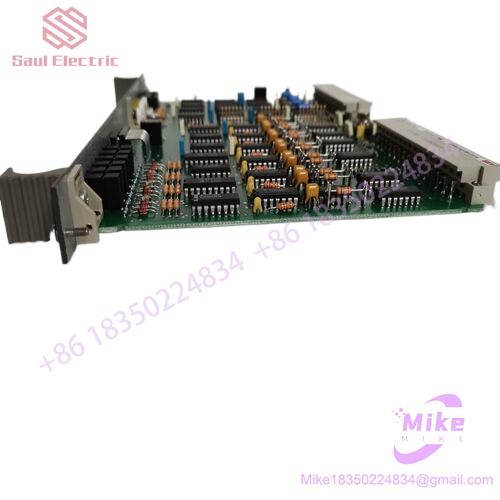
ABB GD9924BE/V2 HIEE401091R0002 Module
core positioning
The module itself is not a simple I/O acquisition card, but an intelligent node that integrates “control+communication+diagnosis”. It receives control instructions from the DCS controller and drives the on-site execution mechanism after real-time computation by the internal dual core ARM processor; Simultaneously collect on-site sensor signals and transmit them back to DCS; And communicate directly with third-party devices through the onboard multi protocol communication interface. The core difference from traditional I/O modules is that it has independent computing capability, can continue to execute local control logic when DCS communication is interrupted, and supports switching communication protocols through firmware upgrades without the need to replace hardware.
Basic Parameters
Material Number: GD9924BE/V2/HIEE401091R0002
Model: GD9924BE/V2 (V2 is the second generation version, with added Ethernet ports compared to V1)
Processor: Dual core ARM architecture, signal processing latency<1ms
Digital I/O: 32 channels (expandable)
Analog I/O: Supports analog signal input/output (the specific number of channels depends on the configuration)
Communication interfaces: Ethernet (Modbus TCP, IEC 61850), CANopen, PROFIBUS DP, three protocols onboard and switchable through firmware
Working voltage: 24V DC ± 20% (optional 90-264V AC wide range input)
Power consumption:<6W (typical value)
Electrical isolation: 2.5kV rms isolation between I/O channel and system side
Protection level: IP67 (can be directly installed outdoors or in control cabinets with high dust and humidity environments)
Working temperature: -25 ° C to+70 ° C
Storage temperature: -40 ° C to+85 ° C
Size: 100mm × 100mm × 50mm (with a width of only 22.5mm, two can be installed side by side in the 50mm panel area)
Weight: Approximately 0.3kg
Mean time between failures:>300 years (Telcordia SR-332 standard)
Compliant with standards: CE, UL 508, IEC 61131-2, RoHS, DNV-GL classification society
Programming method: CoDeSys/IEC 61131-3
Main functional features
Native support for multiple protocols: onboard Ethernet (Modbus TCP/IEC 61850), CANopen, and PROFIBUS DP communication interfaces, which can communicate with three different protocol field devices simultaneously. The core upgrade of V2 version compared to V1 is the addition of Ethernet ports, allowing it to directly connect to SCADA systems of IEC 61850 system without the need for additional protocol conversion gateways. The firmware can be remotely upgraded through a USB service cable (TK501), and the same card can be reassigned from today’s PROFIBUS to tomorrow’s Ethernet without the need for hardware replacement.
High speed deterministic control: The dual core ARM processor achieves a signal processing delay of<1ms, with a built-in redundant switching mechanism (switching time<50ms). When working in conjunction with the module, the partner module can seamlessly take over without affecting the process, ensuring that the control loop is not interrupted. This feature makes it suitable for continuous production scenarios that require high availability.
High level electrical isolation: The 2.5kV rms isolation between the I/O channel and the system side is much higher than the 1.5kV standard of ordinary communication modules. It can effectively block the impact of on-site grounding circuits and high-frequency transients on DCS controllers, and is suitable for power plants and heavy industry sites with strong interference.
Onboard diagnosis and status broadcast: The built-in diagnostic function broadcasts the module’s health status, power supply voltage, and I/O status in real-time through the fieldbus. The 800xA panel can display warning information before a fault occurs, making it easy for operation and maintenance personnel to intervene in advance. The onboard LED indicator provides intuitive feedback on TX/RX activity and link health status.
Compact fanless design: passive cooling, width only 22.5mm, power consumption<6W, can be densely installed without adding additional HVAC. With an IP67 protection level and a working temperature range of -25 ° C to+70 ° C, it can be directly installed in environments where the temperature inside the cabinet reaches 55 ° C during summer.
Parameterized configuration: Supports online configuration of I/O channels, filtering time, communication parameters, and control logic through ABB’s dedicated industrial control software. The configuration takes effect in real time, reducing downtime for debugging.
Start self check: Automatically check the electrical ID of the module when powered on, and do not enter the running state when it does not match the configuration, to prevent control abnormalities caused by mismatches.
Hot swappable support: Supports replacement while the rack is powered on, and maintenance can be completed without cutting off the system power supply, reducing the risk of downtime.
Comparison with products in the same series
GD9924BE/V1: Early version, only supports CANopen and PROFIBUS DP, without Ethernet port, suitable for old projects that do not require IEC 61850 communication. The core upgrade of GD9924BE/V2 involves the addition of Ethernet and improved processing speed and diagnostic capabilities.
GD9924BE/V3: The upcoming version supports 802.11ax wireless communication and is suitable for cable free I/O scenarios. It has not been officially released yet.
SA9923A-E (HIEE450964R0001): Both ABB intelligent control modules, but positioned as basic I/O slave stations, do not have the multi protocol switching and high-speed control capabilities of GD9924BE/V2. The structure is simpler and suitable for scenarios that only require digital data acquisition.
FM9925A-E (HIEE45116R0001): An I/O module designed for analog processing, with channel configuration primarily based on analog signals, which is completely different from the control and communication positioning of GD9924BE/V2.
CI858-1 (3BSE018137R1): AC 800M wired Ethernet module, which overlaps with the Ethernet part of GD9924BE/V2, but CI858-1 only provides communication function and does not have local logic control capability. It needs to be used in conjunction with CPU. GD9924BE/V2 integrates “communication+control” and can operate independently.
Typical application scenarios
Power industry: Communication and control between the DCS of the generator set and the turbine governor, while connecting protective relays to achieve status monitoring. The dual port design precisely meets the dual device access requirements of “governor+relay”, and IEC 61850 supports direct access to power station SCADA.
Metallurgical industry: Sequential control and cross restriction logic for steel reheating furnace burners, IP67 protection and passive heat dissipation design to ensure long-term stable operation in high temperature and high vibration environments.
Hydroelectric power station: Connect the guide vane position signal to the turbine protection system through IEC 61850 GOOSE to achieve fast interlocking control.
Chemical industry: Digital interlocking expansion of chemical packaging lines, adding 32 digital I/O channels without pulling new multi-core cables, reducing on-site wiring workload.
Oil and gas: Serial data exchange between SCADA system and on-site RTUs, intelligent instruments, 2.5kV electrical isolation protection DCS from the transient effects of high-power equipment switches.





