


Description
ABB FAU810 flame detection module
Introduction to ABB FAU810 Flame Analysis Unit
ABB FAU810 is an ABB Uvisor ™ A smart flame analysis unit in the series, which belongs to the core signal processing and judgment equipment of combustion monitoring systems. It does not directly perceive flames, but receives raw light signals from flame detectors (probes), analyzes, filters, and logically judges them through high-speed digital algorithms, and outputs highly reliable “fire/no fire” commands and flame quality data. It is the key center for converting light signals into control commands in boiler combustion safety management systems.
core positioning
FAU810 is the ‘brain’ of the flame detection system. The front-end collects ultraviolet, infrared, or visible light signals of flames through flame scanning heads or flame rods such as SF810 and DFS, and transmits them to FAU810 through optical fibers or cables. FAU810 performs real-time analysis on signals to distinguish between real flames and background radiation interference (such as reflected light from furnace walls and adjacent burner blowouts), and ultimately outputs key data such as flame status, intensity, and quality to DCS or safety interlock systems for driving safety actions such as boiler trip protection and fuel cut-off.
Basic Parameters
Material number: FAU810 (C10-12010 is a fully assembled version with dual Profibus DP-V1 redundant communication)
Model: FAU810
Series: Uvisor ™ FAU Series
System: ABB AC800M/Symphony Plus DCS
Number of channels: 2 independent channels, each channel can be connected to a flame detector
Detector compatibility: SF810 series scanning heads (UV/IR/UVIR/PAYRO), DFS series scanning heads, Flame Rods
Sampling rate: 2000 times/second
Signal processing: high-speed digital algorithm, real-time calculation of flame flicker frequency, AC amplitude, combustion index, flame quality index
Working voltage: 24V DC (supporting a wide range of 21.6V to 31.2V, with redundant dual power supply)
Communication interface: redundant Profibus DP-V1 (12 Mbit/s) or Modbus RTU, 2 RS-485 interfaces (one per channel, supporting redundancy)
Analog output: 2-channel 4-20mA isolated output (configurable as flame intensity, frequency, quality, or AC amplitude)
Relay output: 3-channel SPDT relay (flame # 1, flame # 2, flame # 3/fault)
Digital input: 2-channel DI, used for remote parameter switching (such as switching between fuel/coal operating conditions)
Electrical isolation: Isolation between channels and buses ≥ 1500V
Protection level: IP65/IP66 (NEMA 4)
Working temperature: -40 ° C to+85 ° C
Storage temperature: -40 ° C to+85 ° C
Size: Approximately 89.9mm × 269mm × 190mm (rail mounted)
Weight: Approximately 0.5kg to 0.9kg (including terminal board)
Safety certification: ATEX/IECEx (Ex II 2GD T6), SIL-2/SIL-3 (IEC 61508)
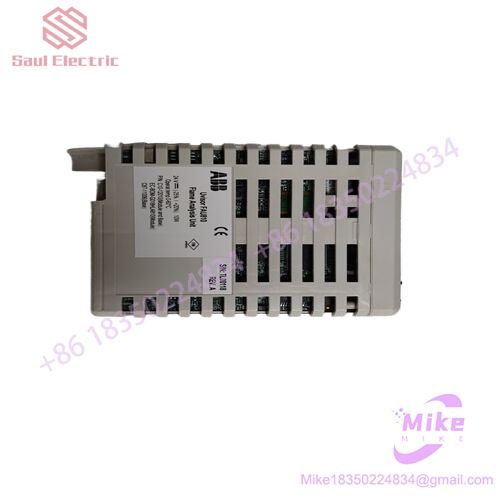
ABB FAU810 flame detection module
Main functional features
Dual channel independent processing: Each FAU810 is equipped with two completely independent signal processing channels, which can simultaneously monitor the flame status of two burners without interfering with each other. Two channels can be connected to different types of detector combinations (such as an SF810 infrared probe+a flame rod).
Intelligent flame analysis algorithm: Sampling input signals at a rate of 2000 times per second, real-time calculation of flame flicker frequency, AC amplitude, combustion index and other characteristic values, and accurate identification of real flames and interference radiation through preset threshold comparison. Built in adaptive filter, which can suppress the influence of background light (such as direct sunlight) and electromagnetic noise (such as frequency converter harmonics) on the signal.
Flame Quality Index: FAU810 continuously calculates the flame quality value, which is like a “health barometer” that can intuitively reflect flame stability, warn potential extinguishing risks in advance, and help operation and maintenance personnel intervene before faults occur.
Fuel adaptive database: Built in fuel adaptive function, which can automatically optimize detection sensitivity based on fuel type (coal/oil/gas) and burner layout (hedging/rounding). Support working condition learning mode, automatically generate background values, cutoff frequency, gain and other parameters through “fire/no fire” scanning, and store them in non-volatile memory. The response time during fuel switching is less than 500ms, greatly reducing the need for manual calibration.
Redundant communication and remote operation and maintenance: Equipped with dual redundant Profibus DP-V1 or Modbus RTU interfaces, supporting daisy chain topology, a single bus can connect up to 254 detection units. Through Flame Explorer ™ The software can achieve remote parameter download, trend archiving, and extended diagnosis (supporting 1-year historical data storage). A power plant has achieved centralized monitoring of flame signals throughout the plant through this function, reducing wiring costs by 40%.
Self diagnosis and fault monitoring: The hardware self check cycle is 0.1 seconds, and real-time monitoring of detector optical path pollution, electronic component aging, communication interruption and other abnormalities is carried out. Fault information is synchronized through relays, buses, and LCDs to quickly locate whether the fault is caused by the probe, fiber optic cable, or amplifier itself.
Local operating interface: equipped with a graphical LCD (4 lines x 20 characters) and 4 buttons, allowing for on-site viewing of flame status, quality index, fault codes, and parameter settings. The programming mode is equipped with password lock and DIP switch protection to prevent accidental operation.
Hot swappable and modular design: supports online replacement, redundant power supplies and communication links ensure uninterrupted operation at a single point of failure. On site functional upgrades can be performed through proprietary firmware download tools to adapt to newly released product features.
Comparison with products in the same series
SF810 is a flame scanning head (front-end probe) responsible for collecting flame light signals; FAU810 is a signal processing unit (backend analyzer) responsible for determining the flame status. The two work together to form a complete flame detection chain. DFS is ABB’s previous generation flame scanning head, and FAU810 is seamlessly compatible with DFS, making it the preferred solution for retrofitting and upgrading old systems. Compared with traditional analog fire detection processors, FAU810 adopts full digital processing instead of drift prone analog circuits, significantly improving signal stability and anti-interference ability.
Typical application scenarios
Power industry: Flame monitoring of coal-fired, oil fired, and gas-fired boilers, flame confirmation of tangential or opposed burners, to prevent furnace explosion or flameout.
Chemical industry: Burner protection for petrochemical cracking furnaces and heating furnaces, stability testing under multi fuel switching conditions.
Metallurgical industry: flame monitoring for blast furnace hot blast stove and steel rolling heating furnace.
Environmental protection industry: Multi fuel (garbage/natural gas/diesel) collaborative combustion control for garbage incinerators.
Gas turbine: flame confirmation and safety interlock during start stop process.





